

USAF Special Warfare Patch - Hook & Loop Back - 4.75 X 2.5" Chest Rig Patch
USAF Special Warfare Patch - Hook & Loop Back - 4.75 X 2.5" Chest Rig Patch
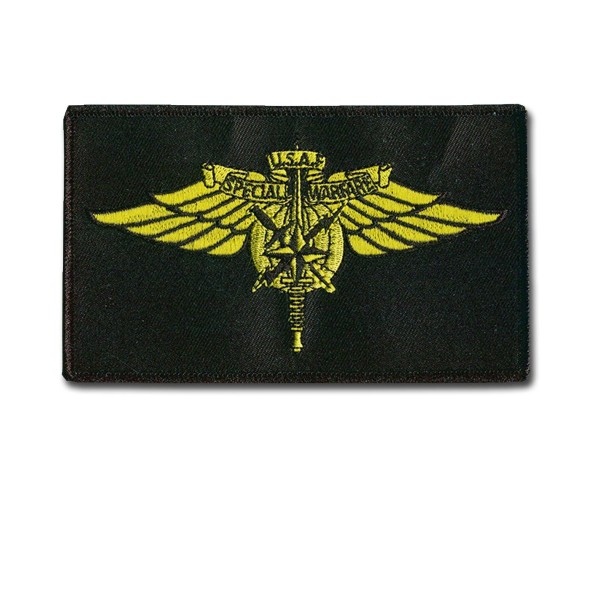
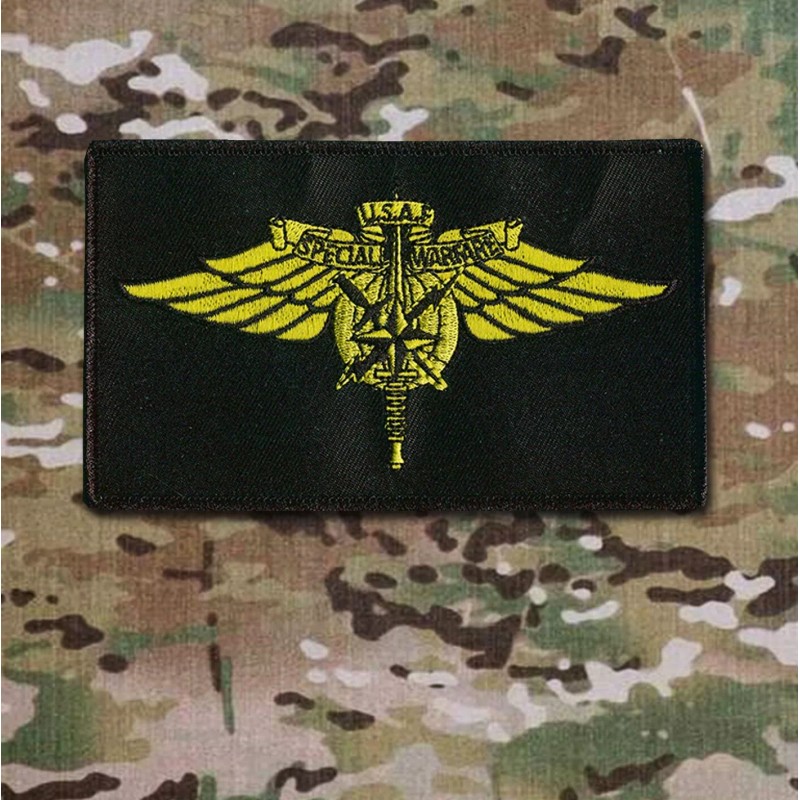
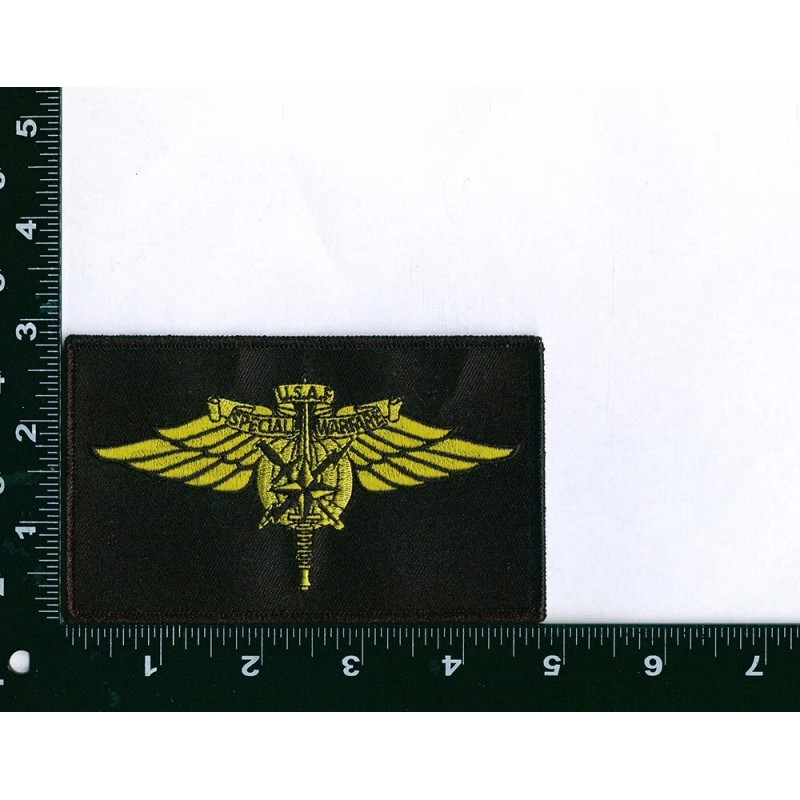


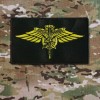
USAF Special Warfare Patch - Hook & Loop Back - 4.75 X 2.5" Chest Rig Patch
USAF Special Warfare Patch - Hook & Loop Back - 4.75 X 2.5" Chest Rig Patch
The Airmen who make up Air Force Special Warfare are the most specialized warriors on the planet. They are the ones other special forces look to when the mission calls for their unique skills and fearless commitment. A job for the mentally tough and physically strong, these elite heroes go where others won’t because they’re trained to do what others can’t.
There are few things that can change the course of battle like a properly executed air strike. As members of Air Force Special Warfare, Tactical Air Control Party (TACP) imbeds with Army and Marine units on the frontline with the incredible responsibility of calling in an air strike on the right target at just the right time. These highly trained experts go through intense physical, mental and technical training in order to withstand the demanding conditions of battle and provide their team with the firepower they need for continued success on the battlefield.
A United States Air Force Tactical Air Control Party, commonly abbreviated TACP, is an individual or team of United States Air Force Special Warfare Airmen with AFSC 1Z3X1, who are aligned with conventional, Special Operation Forces, and Tier 1 combat maneuver units. They provide precision terminal attack control and terminal attack guidance of U.S. and coalition fixed- and rotary-wing close air support aircraft, artillery, and naval gunfire; establish and maintain command and control (C2) communications; and advise ground commanders on the best use of air power.
TACPs are Special Warfare airmen who operate in multiple contexts. Most commonly, TACPs serve as the principal Air Force liaison element to the United States Army (USA), where they align with combat maneuver echelons from Corps to Battalion level. The TACP provides its aligned Army unit with expertise in planning and executing airpower in support of the land component commander's scheme of maneuver. In special operations settings, TACPs deploy with "white" SOF units, including Air Force Special Tactics, Army Special Forces, and Navy SEAL teams, as well with Army Rangers and Joint Special Operations Command Special Mission Units, acting primarily as precision airstrike controllers, communications, and command-and-control experts.
Overview
The USAF TACP, when operationally employed as an element of the Theater Air Control System (TACS), is subordinate to the Air Support Operations Center (ASOC), which in turn is subordinate to the Air Operations Center (AOC). The AOC is the senior TACS agency responsible for the centralized control and decentralized execution of airpower in support of the Joint Force Commander. The USAF/USA Memorandum requires the USAF to provide Air Liaison Officers, Battalion Air Liaison Officers, enlisted technicians (1Z3X1s) skilled in planning, requesting, and managing airpower resources, and 1Z3X1 Joint Terminal Attack Controllers (JTACs). JTACs are specially trained and certified airmen who provide terminal control of airpower, usually in the form of Close Air Support missions. The TACP also provides USAF Intelligence, Space, Electronic Warfare, Weather, and other liaisons to the Army. These liaisons serve as USAF subject-matter experts within their areas of expertise and assist in planning and integrating these functions with their aligned Army unit. All of these USAF liaison personnel are assigned to a USAF Air Support Operations Squadron. Operationally, liaisons serve within a TACP aligned with an Army Brigade Combat Team (BCT), Division, or Corps. 1Z3X1s and Air Liaison Officers serve in TACPs at Army echelons from battalion through corps.
Overview of the AFSC
Until 2015, initial AFSC training for TACP Candidates took place at Hurlburt Field, FL, an annex of Eglin Air Force Base and home to Air Force Special Operations Command. Training was subsequently moved to the Chapman Training Annex of Lackland Air Force Base in San Antonio, TX, where the initial selection and training for all Air Force Special Warfare career fields now takes place. Graduates of the TACP schoolhouse (AFSC 1Z3X1) attend USAF Survival, Evasion, Resistance, and Escape (SERE) School at Fairchild AFB, WA, and Basic Airborne School at Ft. Benning, GA, and the Joint Terminal Attack Controller Qualification Course at Nellis AFB, NV, after which they are assigned to a TACP unit to undergo initial mission readiness training and skill level upgrade.
Most TACP personnel are assigned to Air Support Operations Squadrons (ASOS), which are organized, trained and equipped to perform one of two functions, that of a Tactical Air Control Party or an Air Support Operations Center (ASOC). 1Z3X1s are experts on man-portable, vehicle-mounted, and field-expedient communications and are trained in weapons and fieldcraft, including navigation, individual and crew-served weapons systems, small unit tactics, demolitions, and Close Air Support tactics, techniques, and procedures (TTPs).
Air Support Operations Squadrons
The USAF Air Support Operations Squadron (ASOS), which derives its name from the Close Air Support that TACPs specialize in, is usually located on an Army installation. An ASOS is commanded by an Air Force Lieutenant Colonel who also serves as the senior Air Liaison Officer for an Army Division. The TACP mission is to support the host Army division and its subordinate brigade combat teams (BCTs), which are the basic deployable unit in the US Army. TACPs are located on nearly all major Army installations, and 1Z3X1s are primarily assigned to various ASOSs on Army installations throughout the U.S and overseas during their careers. As an unstated prerequisite to a career as a 1Z3X1, it is understood that 1Z3X1s live, train and deploy with U.S. Army combat units worldwide under some of the most demanding and difficult conditions in often very austere environments. Additionally, there are numerous ASOSs within the Air National Guard that have actively participated in combat operations worldwide supporting the Global War on Terror since 9/11.
When assigned to a TACP, the mission of the 1Z3X1 is to advise and assist Army ground commanders and fire support officers in planning, integrating, requesting, and employing airpower consistent with Joint Army, and Air Force doctrine and tactics, techniques, and procedures. Because of their unique position in the USAF, which places enlisted airmen in positions of authority and responsibility normally placed on commissioned officers, 1Z3X1s must be thoroughly proficient in their specialty and experts on airpower and joint operations, while also possessing the skills and training necessary to seamlessly fit in with the joint service unit to which they are assigned. During a TACP assignment, 1Z3X1s must continually possess a high degree of self-motivation, enthusiasm and a willingness to operate often as the lone airman in a joint team. Though challenging, a TACP assignment has its rewards: 1Z3X1s are uniquely afforded the opportunity to increase their knowledge, skills, and operator capabilities by attending Military Freefall, Air Assault, Pathfinder, Ranger, and Special Forces Combat Diver schools.
Air Support Operations Center
The Air Support Operations Center (ASOC) is an element of the Theater Air Control System (TACS) aligned with the senior Army maneuver unit (Division or Corps/Corps equivalent) in theater and directly subordinate to the Air Operations Center, which is the senior TACS agency in a theater. Organizationally, ASOCs are also Air Support Operations Squadrons and named as such, but organized and equipped as an ASOC. ASOCs are commanded by an Air Force Lt Col. The ASOC manages allotted air resources and executes missions supporting its aligned Army units. 1Z3X1s assigned to an ASOC fill a vital role by receiving air support requests from forward deployed JTACs. Once an air support request is received, the air support request is either approved or disapproved by the ground commander's land component chain of command. If approved, immediate requests to support urgent, troops-in-contact situations may result in strike aircraft being sent by the ASOC to the JTACs location for terminal control of immediate close air support. Approved, but non-urgent, air support requests submitted after the cut-off time for inclusion on the next Air Tasking Order will become scheduled missions on the subsequent Air Tasking Order. If an air support request is disapproved, the disapproved request should be sent back to the requesting unit with reasons for disapproval. Approval and disapproval authority of air support requests is the responsibility of the Army / Land Component being supported.
Special Tactics TACP
The US Special Operations Command was established in 1987 at MacDill AFB, FL. One MSgt. 1Z3X1 (then AFSC 275X0) was assigned to the command as a liaison, but the position was disestablished in approximately 1991. In 1997, two MSgt. JTAC-qualified 1Z3X1s assigned to the 17th ASOS at Ft. Benning, GA were selected for assignment to two of the Air Force Special Operations Command's Special Tactics Squadrons. TACP flights have been co-located with each Army Special Forces Group, each of the 75th Ranger Regiment's three battalions, and the 160th Special Operations Aviation Regiment (Airborne). TACPs deployed with Operational Detachment Alpha teams from multiple Special Forces groups and with the 75th Ranger Regiment in both Operation Enduring Freedom (OEF) and Operation Iraqi Freedom (OIF). Additionally, in OIF, a small number of TACP personnel were assigned to the US Air Force's 24th Special Tactics Squadron (STS), the Air Force's Joint Special Operations Command (JSOC) special mission unit, and to a time-sensitive targeting (TST) cell dedicated to prosecuting high-value targets and targets of opportunity in support of JSOC's special mission units and their objectives.
In 2008, following its transfer from Air Combat Command to Air Force Special Operations Command, the 17th ASOS (Ft. Benning, GA), which provided JTACs and ALOs to the 75th Ranger Regiment and its three line battalions, was redesignated the 17th Special Tactics Squadron. JTAC-qualified 1Z3X1s at the "5" or "Journeyman" skill level may apply for a Special Tactics assignment within Air Force Special Operations Command (AFSOC). TACP personnel at the 17th STS (and, in smaller numbers, at the four remaining active-duty CONUS Special Tactics Squadrons), provide terminal attack control and fire support expertise for the 75th Ranger Regiment's three Ranger Battalions and Regimental Reconnaissance Company, all seven Army Special Forces Groups, and multiple Navy SEAL Teams. TACPs who have successfully undergone screening and selection are also currently serving as Tier 1 operators with the 24th STS.
TACP Officer (Tactical Air Control Party)
The USAF TACP Officer or TACPO (formerly r) is assigned to an ASOS or ASOC as the USAF airpower advocate, subject-matter expert, and advisor to his or her aligned Army or Marine staff. Until 2009, this USAF officer was a rated officer. In 2005, then Captain Mark R. Wisher submitted an Innovative Development through Employee Awareness (IDEA) Report submission through the Air Force's IDEA program office based on his 2004 Master's Thesis which proposed the creation of a brand new non-rated ALO career field. The IDEA program submission was staffed at Headquarters AF (HAF/A3O) for consideration and ultimately resulted in a HAF-funded RAND Report that was completed in 2008. The RAND report relied heavily on the previous research of Wisher, John Olivero, and Raymond Knox. The RAND report ultimately concurred with Wisher's recommendation to create a non-rated ALO career field. The following year, the USAF created a new non-rated Air Liaison Officer AFSC, 13L, to form a career force of professional Air Liaison Officers and the AF began the first beta class of non-rated ALOs in the summer of 2009. Upon completion of initial qualification training, these non-rated officers are awarded the 13L AFSC. Sometime in 2019, the Air Force changed the name of the 13L AFSC from Air Liaison Officer to TACP Officer.
Potential 19ZBs will first attend a two phase assessment and selection process before attending their initial skills training. Phase I involves completing an application and PAST that is submitted to a review board of TACP Officers. If the review board sees potential in a candidate, they will invite the candidate to Phase II, also called TOPT (TACP Officer Phase Two). TOPT involves one week of extensive testing and evaluation by TACP Cadre to see if candidates are capable of operating in the rigorous TACPO career field. Events at TOPT include numerous written and psychological tests and interviews, Group Leadership Problems (GLPs), long distance runs and ruck marches with combat gear and rigorous physical training. If candidates are selected they will attend the TACP Officer Prep Course followed by the TACP Officer Basic Course based at Lackland AFB, TX; the Joint Firepower Course (JFC) and Basic ALO Skills Course (BASC) at Nellis AFB, NV; and finally Air Force SERE School at Fairchild AFB, WA.
The TACPO represents the Joint/Combined Forces Air Component Commander as a member of the Army commander's special staff at the Battalion through Corps echelons in a coalition, joint, or interagency force. He or she provides subject matter expertise to lead, plan, and manage Command-and-Control and terminal execution of Air, Space, and Cyber operations in direct support of land component forces. The TACPO assists in developing fire support coordination plans to include Close Air Support (CAS), Air Interdiction (AI), Intelligence, Surveillance and Reconnaissance (ISR), Electronic Warfare (EW), and Suppression/Destruction of Enemy Air Defenses (SEAD/DEAD). The TACPO may engage enemy forces using advanced technologies and weapon systems to direct lethal and non-lethal fires and effects in close proximity to friendly forces as a Joint Terminal Attack Controller (JTAC). Additional TACPO training may include, but are not limited to:
US Army Airborne School - Three week course at Fort Benning where attendees learn the basics of static-line parachute operations.
Joint Terminal Attack Controller Qualification Course - Four week course at Nellis AFB, NV where attendees qualify as JTACs.
Air Force Special Tactics TACP Advance Skills Course - 12 week course put on by the Special Tactics Training Squadron at Hurlburt Field, Fla. where ST TACPO learn and enhance necessary skills required to operate within USSOCOM units.
Ranger Assessment and Selection (RASP 2) - Three week selection course for senior NCOs, Officers, and Warrant Officers for leadership positions within the 75th Ranger Regiment. RASP 2 tests candidates on their physical and mental capabilities while learning the special tactics, techniques and procedures of the 75th Ranger Regiment (Note: TACPOs assigned to the 17th Special Tactics Squadron, the Air Force unit assigned to provide TACP and TACPO to the regiment, must attend RASP 2).
TACP Beret and History
Tactical Air Control Party Crest
Tactical Air Control Party beret flash
In 1979, the black beret was authorized for wear by enlisted personnel in the Tactical Air Control Party. In 1984, two airmen from Pope Air Force Base, North Carolina submitted the current flash and crest design. It was approved for all TACP airmen in 1985. Tactical Air Control Party specialists (AFSC 1Z3X1) are currently the only United States Air Force specialty allowed to wear the coveted black beret as part of their daily duty uniform wear. TACP Officers (TACPOs) are also authorized to wear the black beret after they graduate from the Basic ALO Skills Course (BASC), conducted at Nellis Air Force Base, Nevada.
TACP Flash and Crest Heraldry
The US Air Force ordinary holds the position of honor at the top of the crest. It is supported by the erect wings, which symbolize the combat ready United States Air Force and the Theater Air Control System. At the bottom of the wings rests the TACP ordinary, representing the most forward element of the Theater Air Control System. The sword symbolizes the strength and firepower controlled by the TACP, while the lightning bolt represents a modern-day standard for communications, the backbone of the TACP. The eight-point omni-directional star symbolizes the worldwide mobility commitment of the TACP, as well as his ability to navigate over all terrain. The scarlet border of the cloth flash symbolizes the immense firepower that can be brought to bear when Air Force and Army assets are combined. The red dovetail divider symbolizes the strong interlocking relationship between the Army, the field of green, and the Air Force, the field of blue, created by the liaison functions of the TACP.
1Z3X1 Initial Qualification Training
After graduating Basic Military Training, all enlisted 1Z3X1 candidates are sent to Medina Annex of Lackland AFB, TX to attend a five-day indoctrination course. Those candidates who successfully complete indoctrination attend the 85-day 1Z3X1 3-level (Apprentice) initial qualification training course at Lackland AFB, TX. The 3-level course was held at Hurlburt Field, Florida for 36 years prior to the July 2015 move to Texas. Those who successfully complete the initial training course are awarded the "3" or "apprentice" skill level and then attend the USAF Survival School at Fairchild AFB, WA. Not including the TACP Preparatory Course, the attrition rate of the 1Z3X1 3-level course has been approximately 70%, with some classes reaching a 90% attrition rate. This relatively high rate is primarily attributed to the constant physical demands students face throughout the entire length of the course, with the difficulty level increasing until graduation. The relentless physical demands combined with a challenging academic curriculum require constant focus on attention to detail. After completing initial training and arriving at the first duty station, training continues with the goal of obtaining Combat Mission Readiness. After one year of maintaining Combat Mission Ready (CMR) status and possessing the "5" or "journeyman" skill level, 1Z3X1s are eligible to attend the Joint Terminal Attack Controller qualification course at Nellis AFB, or if stationed in Germany or Italy, the USAFE Air-Ground Operations School. Course attendance is based on training NCO and commander recommendation and is not guaranteed.
| Isin: | INDG9HXRZ5EQ |
|---|
Out of Stock
In Stock
Backordered
Out of Stock



IBspot Buyer Protection
Shop confidently on IBspot, receive your item as described or your money back for eligible orders. Learn Program Terms
GUARANTEED SAFE CHECKOUT
-

MONEY BACK GUARANTEE
30 days money back guarantee, no additional fee charged.
-

EXCELLENT SUPPORT
We provide 24/7 online customer support via email.
-

Fast Shipping
One week domestic shipping. Global delivery to the US in 2 weeks.
USAF Special Warfare Patch - Hook & Loop Back - 4.75 X 2.5" Chest Rig Patch
The Airmen who make up Air Force Special Warfare are the most specialized warriors on the planet. They are the ones other special forces look to when the mission calls for their unique skills and fearless commitment. A job for the mentally tough and physically strong, these elite heroes go where others won’t because they’re trained to do what others can’t.
There are few things that can change the course of battle like a properly executed air strike. As members of Air Force Special Warfare, Tactical Air Control Party (TACP) imbeds with Army and Marine units on the frontline with the incredible responsibility of calling in an air strike on the right target at just the right time. These highly trained experts go through intense physical, mental and technical training in order to withstand the demanding conditions of battle and provide their team with the firepower they need for continued success on the battlefield.
A United States Air Force Tactical Air Control Party, commonly abbreviated TACP, is an individual or team of United States Air Force Special Warfare Airmen with AFSC 1Z3X1, who are aligned with conventional, Special Operation Forces, and Tier 1 combat maneuver units. They provide precision terminal attack control and terminal attack guidance of U.S. and coalition fixed- and rotary-wing close air support aircraft, artillery, and naval gunfire; establish and maintain command and control (C2) communications; and advise ground commanders on the best use of air power.
TACPs are Special Warfare airmen who operate in multiple contexts. Most commonly, TACPs serve as the principal Air Force liaison element to the United States Army (USA), where they align with combat maneuver echelons from Corps to Battalion level. The TACP provides its aligned Army unit with expertise in planning and executing airpower in support of the land component commander's scheme of maneuver. In special operations settings, TACPs deploy with "white" SOF units, including Air Force Special Tactics, Army Special Forces, and Navy SEAL teams, as well with Army Rangers and Joint Special Operations Command Special Mission Units, acting primarily as precision airstrike controllers, communications, and command-and-control experts.
Overview
The USAF TACP, when operationally employed as an element of the Theater Air Control System (TACS), is subordinate to the Air Support Operations Center (ASOC), which in turn is subordinate to the Air Operations Center (AOC). The AOC is the senior TACS agency responsible for the centralized control and decentralized execution of airpower in support of the Joint Force Commander. The USAF/USA Memorandum requires the USAF to provide Air Liaison Officers, Battalion Air Liaison Officers, enlisted technicians (1Z3X1s) skilled in planning, requesting, and managing airpower resources, and 1Z3X1 Joint Terminal Attack Controllers (JTACs). JTACs are specially trained and certified airmen who provide terminal control of airpower, usually in the form of Close Air Support missions. The TACP also provides USAF Intelligence, Space, Electronic Warfare, Weather, and other liaisons to the Army. These liaisons serve as USAF subject-matter experts within their areas of expertise and assist in planning and integrating these functions with their aligned Army unit. All of these USAF liaison personnel are assigned to a USAF Air Support Operations Squadron. Operationally, liaisons serve within a TACP aligned with an Army Brigade Combat Team (BCT), Division, or Corps. 1Z3X1s and Air Liaison Officers serve in TACPs at Army echelons from battalion through corps.
Overview of the AFSC
Until 2015, initial AFSC training for TACP Candidates took place at Hurlburt Field, FL, an annex of Eglin Air Force Base and home to Air Force Special Operations Command. Training was subsequently moved to the Chapman Training Annex of Lackland Air Force Base in San Antonio, TX, where the initial selection and training for all Air Force Special Warfare career fields now takes place. Graduates of the TACP schoolhouse (AFSC 1Z3X1) attend USAF Survival, Evasion, Resistance, and Escape (SERE) School at Fairchild AFB, WA, and Basic Airborne School at Ft. Benning, GA, and the Joint Terminal Attack Controller Qualification Course at Nellis AFB, NV, after which they are assigned to a TACP unit to undergo initial mission readiness training and skill level upgrade.
Most TACP personnel are assigned to Air Support Operations Squadrons (ASOS), which are organized, trained and equipped to perform one of two functions, that of a Tactical Air Control Party or an Air Support Operations Center (ASOC). 1Z3X1s are experts on man-portable, vehicle-mounted, and field-expedient communications and are trained in weapons and fieldcraft, including navigation, individual and crew-served weapons systems, small unit tactics, demolitions, and Close Air Support tactics, techniques, and procedures (TTPs).
Air Support Operations Squadrons
The USAF Air Support Operations Squadron (ASOS), which derives its name from the Close Air Support that TACPs specialize in, is usually located on an Army installation. An ASOS is commanded by an Air Force Lieutenant Colonel who also serves as the senior Air Liaison Officer for an Army Division. The TACP mission is to support the host Army division and its subordinate brigade combat teams (BCTs), which are the basic deployable unit in the US Army. TACPs are located on nearly all major Army installations, and 1Z3X1s are primarily assigned to various ASOSs on Army installations throughout the U.S and overseas during their careers. As an unstated prerequisite to a career as a 1Z3X1, it is understood that 1Z3X1s live, train and deploy with U.S. Army combat units worldwide under some of the most demanding and difficult conditions in often very austere environments. Additionally, there are numerous ASOSs within the Air National Guard that have actively participated in combat operations worldwide supporting the Global War on Terror since 9/11.
When assigned to a TACP, the mission of the 1Z3X1 is to advise and assist Army ground commanders and fire support officers in planning, integrating, requesting, and employing airpower consistent with Joint Army, and Air Force doctrine and tactics, techniques, and procedures. Because of their unique position in the USAF, which places enlisted airmen in positions of authority and responsibility normally placed on commissioned officers, 1Z3X1s must be thoroughly proficient in their specialty and experts on airpower and joint operations, while also possessing the skills and training necessary to seamlessly fit in with the joint service unit to which they are assigned. During a TACP assignment, 1Z3X1s must continually possess a high degree of self-motivation, enthusiasm and a willingness to operate often as the lone airman in a joint team. Though challenging, a TACP assignment has its rewards: 1Z3X1s are uniquely afforded the opportunity to increase their knowledge, skills, and operator capabilities by attending Military Freefall, Air Assault, Pathfinder, Ranger, and Special Forces Combat Diver schools.
Air Support Operations Center
The Air Support Operations Center (ASOC) is an element of the Theater Air Control System (TACS) aligned with the senior Army maneuver unit (Division or Corps/Corps equivalent) in theater and directly subordinate to the Air Operations Center, which is the senior TACS agency in a theater. Organizationally, ASOCs are also Air Support Operations Squadrons and named as such, but organized and equipped as an ASOC. ASOCs are commanded by an Air Force Lt Col. The ASOC manages allotted air resources and executes missions supporting its aligned Army units. 1Z3X1s assigned to an ASOC fill a vital role by receiving air support requests from forward deployed JTACs. Once an air support request is received, the air support request is either approved or disapproved by the ground commander's land component chain of command. If approved, immediate requests to support urgent, troops-in-contact situations may result in strike aircraft being sent by the ASOC to the JTACs location for terminal control of immediate close air support. Approved, but non-urgent, air support requests submitted after the cut-off time for inclusion on the next Air Tasking Order will become scheduled missions on the subsequent Air Tasking Order. If an air support request is disapproved, the disapproved request should be sent back to the requesting unit with reasons for disapproval. Approval and disapproval authority of air support requests is the responsibility of the Army / Land Component being supported.
Special Tactics TACP
The US Special Operations Command was established in 1987 at MacDill AFB, FL. One MSgt. 1Z3X1 (then AFSC 275X0) was assigned to the command as a liaison, but the position was disestablished in approximately 1991. In 1997, two MSgt. JTAC-qualified 1Z3X1s assigned to the 17th ASOS at Ft. Benning, GA were selected for assignment to two of the Air Force Special Operations Command's Special Tactics Squadrons. TACP flights have been co-located with each Army Special Forces Group, each of the 75th Ranger Regiment's three battalions, and the 160th Special Operations Aviation Regiment (Airborne). TACPs deployed with Operational Detachment Alpha teams from multiple Special Forces groups and with the 75th Ranger Regiment in both Operation Enduring Freedom (OEF) and Operation Iraqi Freedom (OIF). Additionally, in OIF, a small number of TACP personnel were assigned to the US Air Force's 24th Special Tactics Squadron (STS), the Air Force's Joint Special Operations Command (JSOC) special mission unit, and to a time-sensitive targeting (TST) cell dedicated to prosecuting high-value targets and targets of opportunity in support of JSOC's special mission units and their objectives.
In 2008, following its transfer from Air Combat Command to Air Force Special Operations Command, the 17th ASOS (Ft. Benning, GA), which provided JTACs and ALOs to the 75th Ranger Regiment and its three line battalions, was redesignated the 17th Special Tactics Squadron. JTAC-qualified 1Z3X1s at the "5" or "Journeyman" skill level may apply for a Special Tactics assignment within Air Force Special Operations Command (AFSOC). TACP personnel at the 17th STS (and, in smaller numbers, at the four remaining active-duty CONUS Special Tactics Squadrons), provide terminal attack control and fire support expertise for the 75th Ranger Regiment's three Ranger Battalions and Regimental Reconnaissance Company, all seven Army Special Forces Groups, and multiple Navy SEAL Teams. TACPs who have successfully undergone screening and selection are also currently serving as Tier 1 operators with the 24th STS.
TACP Officer (Tactical Air Control Party)
The USAF TACP Officer or TACPO (formerly r) is assigned to an ASOS or ASOC as the USAF airpower advocate, subject-matter expert, and advisor to his or her aligned Army or Marine staff. Until 2009, this USAF officer was a rated officer. In 2005, then Captain Mark R. Wisher submitted an Innovative Development through Employee Awareness (IDEA) Report submission through the Air Force's IDEA program office based on his 2004 Master's Thesis which proposed the creation of a brand new non-rated ALO career field. The IDEA program submission was staffed at Headquarters AF (HAF/A3O) for consideration and ultimately resulted in a HAF-funded RAND Report that was completed in 2008. The RAND report relied heavily on the previous research of Wisher, John Olivero, and Raymond Knox. The RAND report ultimately concurred with Wisher's recommendation to create a non-rated ALO career field. The following year, the USAF created a new non-rated Air Liaison Officer AFSC, 13L, to form a career force of professional Air Liaison Officers and the AF began the first beta class of non-rated ALOs in the summer of 2009. Upon completion of initial qualification training, these non-rated officers are awarded the 13L AFSC. Sometime in 2019, the Air Force changed the name of the 13L AFSC from Air Liaison Officer to TACP Officer.
Potential 19ZBs will first attend a two phase assessment and selection process before attending their initial skills training. Phase I involves completing an application and PAST that is submitted to a review board of TACP Officers. If the review board sees potential in a candidate, they will invite the candidate to Phase II, also called TOPT (TACP Officer Phase Two). TOPT involves one week of extensive testing and evaluation by TACP Cadre to see if candidates are capable of operating in the rigorous TACPO career field. Events at TOPT include numerous written and psychological tests and interviews, Group Leadership Problems (GLPs), long distance runs and ruck marches with combat gear and rigorous physical training. If candidates are selected they will attend the TACP Officer Prep Course followed by the TACP Officer Basic Course based at Lackland AFB, TX; the Joint Firepower Course (JFC) and Basic ALO Skills Course (BASC) at Nellis AFB, NV; and finally Air Force SERE School at Fairchild AFB, WA.
The TACPO represents the Joint/Combined Forces Air Component Commander as a member of the Army commander's special staff at the Battalion through Corps echelons in a coalition, joint, or interagency force. He or she provides subject matter expertise to lead, plan, and manage Command-and-Control and terminal execution of Air, Space, and Cyber operations in direct support of land component forces. The TACPO assists in developing fire support coordination plans to include Close Air Support (CAS), Air Interdiction (AI), Intelligence, Surveillance and Reconnaissance (ISR), Electronic Warfare (EW), and Suppression/Destruction of Enemy Air Defenses (SEAD/DEAD). The TACPO may engage enemy forces using advanced technologies and weapon systems to direct lethal and non-lethal fires and effects in close proximity to friendly forces as a Joint Terminal Attack Controller (JTAC). Additional TACPO training may include, but are not limited to:
US Army Airborne School - Three week course at Fort Benning where attendees learn the basics of static-line parachute operations.
Joint Terminal Attack Controller Qualification Course - Four week course at Nellis AFB, NV where attendees qualify as JTACs.
Air Force Special Tactics TACP Advance Skills Course - 12 week course put on by the Special Tactics Training Squadron at Hurlburt Field, Fla. where ST TACPO learn and enhance necessary skills required to operate within USSOCOM units.
Ranger Assessment and Selection (RASP 2) - Three week selection course for senior NCOs, Officers, and Warrant Officers for leadership positions within the 75th Ranger Regiment. RASP 2 tests candidates on their physical and mental capabilities while learning the special tactics, techniques and procedures of the 75th Ranger Regiment (Note: TACPOs assigned to the 17th Special Tactics Squadron, the Air Force unit assigned to provide TACP and TACPO to the regiment, must attend RASP 2).
TACP Beret and History
Tactical Air Control Party Crest
Tactical Air Control Party beret flash
In 1979, the black beret was authorized for wear by enlisted personnel in the Tactical Air Control Party. In 1984, two airmen from Pope Air Force Base, North Carolina submitted the current flash and crest design. It was approved for all TACP airmen in 1985. Tactical Air Control Party specialists (AFSC 1Z3X1) are currently the only United States Air Force specialty allowed to wear the coveted black beret as part of their daily duty uniform wear. TACP Officers (TACPOs) are also authorized to wear the black beret after they graduate from the Basic ALO Skills Course (BASC), conducted at Nellis Air Force Base, Nevada.
TACP Flash and Crest Heraldry
The US Air Force ordinary holds the position of honor at the top of the crest. It is supported by the erect wings, which symbolize the combat ready United States Air Force and the Theater Air Control System. At the bottom of the wings rests the TACP ordinary, representing the most forward element of the Theater Air Control System. The sword symbolizes the strength and firepower controlled by the TACP, while the lightning bolt represents a modern-day standard for communications, the backbone of the TACP. The eight-point omni-directional star symbolizes the worldwide mobility commitment of the TACP, as well as his ability to navigate over all terrain. The scarlet border of the cloth flash symbolizes the immense firepower that can be brought to bear when Air Force and Army assets are combined. The red dovetail divider symbolizes the strong interlocking relationship between the Army, the field of green, and the Air Force, the field of blue, created by the liaison functions of the TACP.
1Z3X1 Initial Qualification Training
After graduating Basic Military Training, all enlisted 1Z3X1 candidates are sent to Medina Annex of Lackland AFB, TX to attend a five-day indoctrination course. Those candidates who successfully complete indoctrination attend the 85-day 1Z3X1 3-level (Apprentice) initial qualification training course at Lackland AFB, TX. The 3-level course was held at Hurlburt Field, Florida for 36 years prior to the July 2015 move to Texas. Those who successfully complete the initial training course are awarded the "3" or "apprentice" skill level and then attend the USAF Survival School at Fairchild AFB, WA. Not including the TACP Preparatory Course, the attrition rate of the 1Z3X1 3-level course has been approximately 70%, with some classes reaching a 90% attrition rate. This relatively high rate is primarily attributed to the constant physical demands students face throughout the entire length of the course, with the difficulty level increasing until graduation. The relentless physical demands combined with a challenging academic curriculum require constant focus on attention to detail. After completing initial training and arriving at the first duty station, training continues with the goal of obtaining Combat Mission Readiness. After one year of maintaining Combat Mission Ready (CMR) status and possessing the "5" or "journeyman" skill level, 1Z3X1s are eligible to attend the Joint Terminal Attack Controller qualification course at Nellis AFB, or if stationed in Germany or Italy, the USAFE Air-Ground Operations School. Course attendance is based on training NCO and commander recommendation and is not guaranteed.
- Original/Reproduction: Original
- Theme: Militaria
Processing Time
- We process and ship orders Monday through Friday, excluding holidays.
- Most orders are processed within 1–3 business days, depending on product availability.
- Processing time does not include delivery time, which varies based on your location and the product’s shipping origin.
Shipping Coverage
We currently ship to addresses within the United States only.
Products may ship from:
- Our U.S. warehouses, or
- Our international fulfillment centers (including Korea, Japan, China, Australia, Mexico, Canada, the United Kingdom, and the EU).
Each product page clearly displays the “Ships From” location before checkout.
Shipping Methods & Estimated Delivery
| Shipping Method | Estimated Delivery | Cost |
|---|---|---|
| Free Shipping (US) | 5–10 business days | Free, available on eligible items |
| Standard Shipping (US to US by Item) | 5–10 business days | $6.50 for the first item, $2.00 each additional |
| Standard Shipping (From US Warehouse by Weight) | 3–7 business days | Starts at $6.50, increasing by $2 for every additional 4 oz (0.25 lb) up to 1 lb, then by $4 for each additional pound beyond 1 lb. |
| Extended Delivery (Ships from Overseas Warehouse) | 10–20 business days | $14.50 for the first item, $2.00 each additional |
Shipping costs vary by product weight, quantity and origin. Exact rates and delivery estimates are displayed on each product page and confirmed during checkout.
Free Shipping
We offer free standard shipping on select products or during promotional periods. Availability of free shipping will be displayed on the product page and at checkout.
Carriers
We primarily use USPS and UPS for U.S. deliveries. Items shipped from international warehouses may be handled by partner carriers depending on the country of origin.
Import Duties & Taxes
All import duties and taxes for goods imported into the United States are included in the product price. There are no hidden fees or additional charges at checkout.
Tracking & Notifications
Every order is fully trackable. You will receive a tracking number via email once your order ships. If your order ships in multiple packages, each package will have its own tracking number. If you don’t receive a shipping confirmation immediately, your order is still being processed and will arrive within the estimated timeframe shown at checkout.
You can track your shipment anytime using the Track Your Order page on our website.
Order Changes & Cancellations
If you need to modify or cancel an order, please contact our customer support team as soon as possible. Orders can only be canceled before they ship. Once shipped, cancellations are not possible, but you may request a return after the item is delivered.
Contact: support@ibspot.com
Item Not Received
If your tracking number shows “Delivered” but you haven’t received your package:
- Check with your local USPS or UPS office.
- Confirm that the shipping address provided was correct.
- If the issue remains unresolved, contact support@ibspot.com for assistance.
Damaged or Lost Parcels
If your package arrives damaged or fails to arrive, please contact us immediately. For deliveries to P.O. boxes, ibspot is not responsible for damage caused by weather, temperature, or theft.
Customer Support
For any questions about shipping, tracking, or delivery, our customer support team is here to help.
Email: support@ibspot.com
We’re always happy to help.
Please read our policy carefully before making a purchase.
We aim to ensure every customer has a smooth and transparent experience with ibspot.com.
Order Cancellation Policy
Customers may request to cancel an order before it has been shipped.
Once the package has been shipped, cancellations are no longer possible; however, you may still request a return after receiving your order.
How to Request a Cancellation
You can contact us through:
- Email: support@ibspot.com
- Contact Form: Submit a request through our Contact Us page
Please submit your cancellation request as soon as possible after placing the order to allow us to process it before shipment.
Return Policy
We accept returns for most items within 30 days of delivery for a full refund.
To be eligible for a return:
- The item must be unused, in the same condition as received, and in its original packaging.
- A tracking number must be provided to confirm the return shipment.
Non-Returnable Items
Certain products cannot be returned, including:
- Perishable goods (for example, food, flowers, newspapers, magazines)
- Intimate or sanitary goods
- Hazardous materials or flammable liquids/gases
- Gift cards
- Downloadable software
- Some health and personal care items
Partial Refunds (If Applicable)
Partial refunds may be granted in specific situations, such as:
- Books with obvious signs of use
- Opened CDs, DVDs, software, or vinyl records
- Items not in their original condition, damaged, or missing parts not due to our error
- Items returned more than 30 days after delivery
How to Return an Item
To initiate a return, please contact us at support@ibspot.com with your order number and details about the product you wish to return.
Our team will provide you with return instructions and a prepaid return label.
Shipping Cost for Returns
Please contact us before returning any item.
We will provide a free return shipping label.
If a return is sent back without prior contact or without our provided label, we cannot be held responsible for return shipping costs.
For items valued over $75, we recommend using a trackable shipping service or purchasing shipping insurance.
We cannot guarantee that we will receive your returned item if shipped independently.
Refund Processing
Once your return is received and inspected:
- In-store returns are refunded to the original form of payment or issued as a gift card.
- Mail-in returns using our prepaid label are refunded to the original payment method within 3–5 business days after we receive your return.
Please allow:
- 5–7 business days for the return to reach our Returns Center.
- An additional 3–10 business days for your bank to post the refund to your account.
Damages, Issues & Claims
Please inspect your order immediately upon receipt.
If you receive a defective, damaged, or incorrect item, contact us right away at support@ibspot.com.
We’ll evaluate the issue promptly and make it right.
Product Claims
Before purchasing, please review product details carefully.
If there is a problem with your order upon arrival, visit our Support Center or contact us directly to arrange return shipping or replacement.
Exchanges
We do not process direct exchanges.
The fastest way to get what you need is to return the original item and place a new order once your return is accepted.
Return Address
IBSPOT Return Center
15 Sawmill Ln
Dover Plains, NY 12522
United States
Customer Support
Our support team is available 24/7 to assist with cancellations, returns, or general inquiries.
Email: support@ibspot.com
Contact Form: Contact Us page

Oops!
Sorry, it looks like some products are not available in selected quantity.