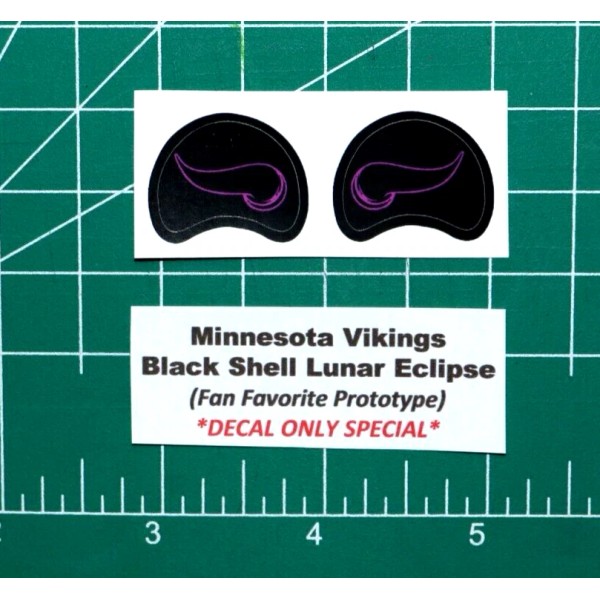
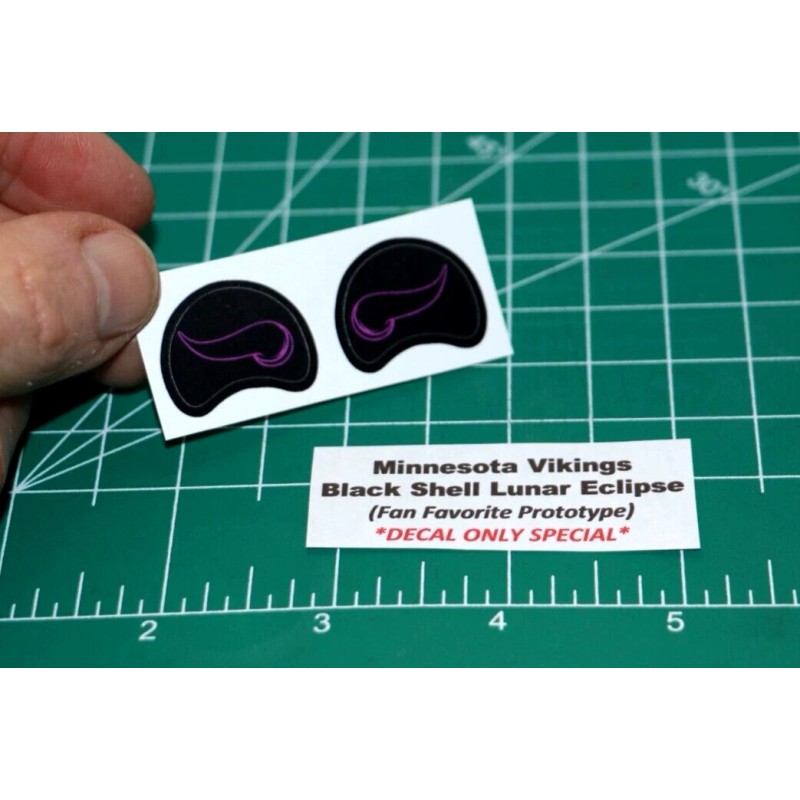
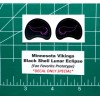
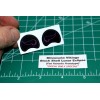
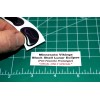
You will receive (1) one CUSTOM MADE diecut decal sheet
CREATED FOR THE OLD OPI / AA (Orange Products Inc) helmet shells with the logo
made for the:
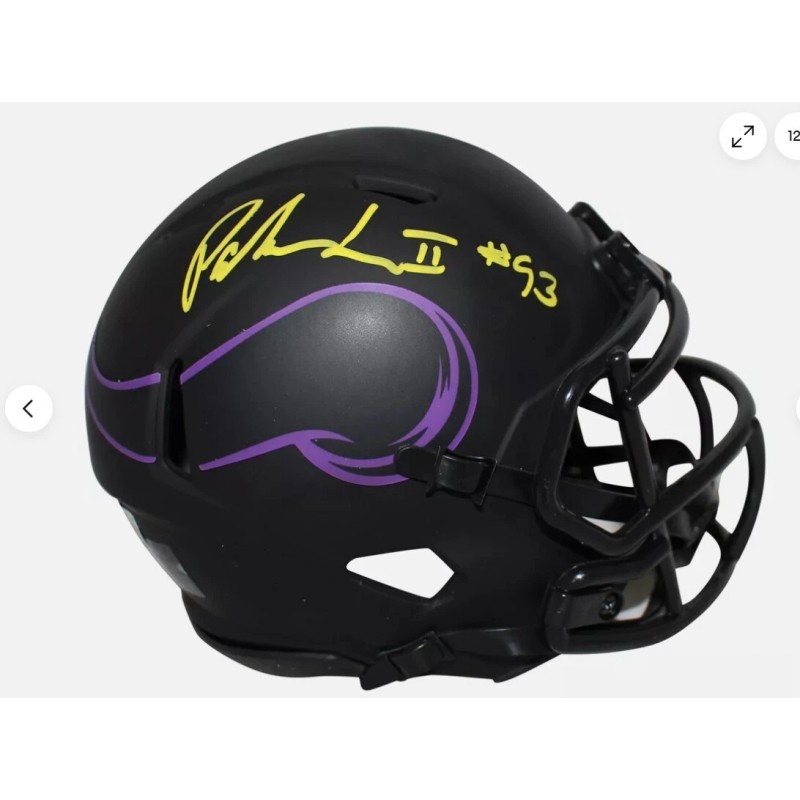
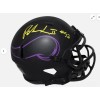
2024 - Current (BLACK SHELL Lunar Eclipse Alt) Minnesota Vikings Fan Favorite Helmet
TAKE NOTE: See extra pictures
as reference.
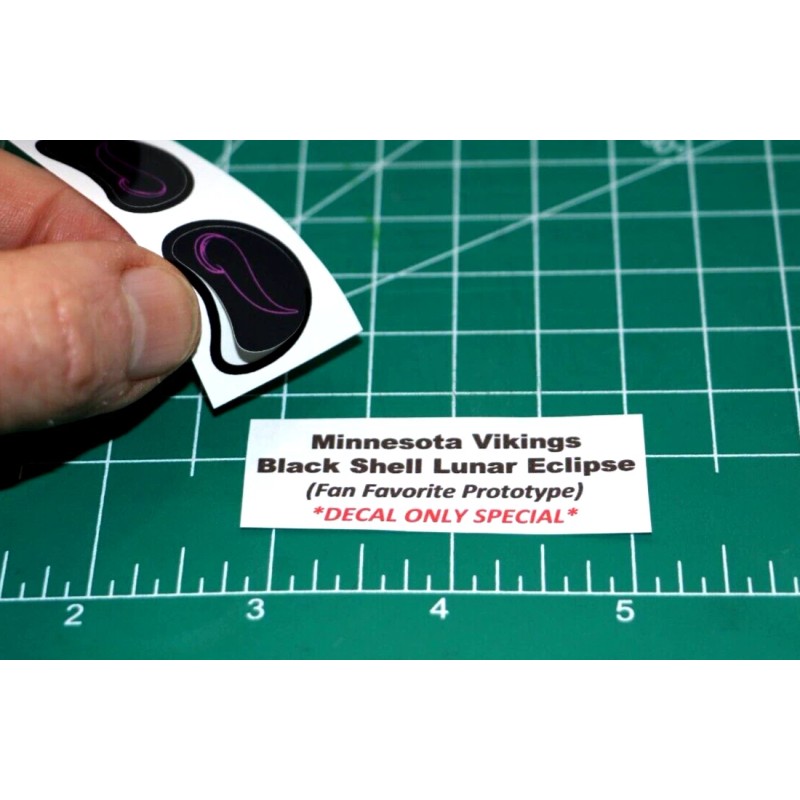
The CUSTOM MADE diecut decal sheet will arrive ready for
you to peel and stick! The die cut decal sheet gives you the PERFECT EDGE on
the decals!
You can assemble your miniature football helmet, just like
the old days when we would get them in the 25 cent gumball helmet machines at
the grocery store ... or in the old JCPenney or Sears OPI Yellow Field Goal
mini miniature NFL AFL NFC AFC helmet kits and Candy Gum Toy Machines NFL
emblems from the 1970’s and 1980’s and 1990’s
Good luck! And remember, shipping is ALWAYS free for my
*DECAL SHEET ONLY* Specials! Order as many as you need! Please try
to buy more than one decal … stamps are getting expensive!
The decal sheet will come from a non-smoking home in
BEAUTIFUL Upstate NY
Bill Boyer served as the team president from 1960 to 1964. Joe Thomas was hired as head scout. Minnesota's first management team was led by general manager Bert Rose, who was appointed as GM on August 5, 1960. In an article on August 6, 1960, in the Minneapolis Tribune, it was reported that the team would use the name "Minnesota" instead of "Minneapolis–Saint Paul". The article also stated that several nicknames were suggested for the team, including "Chippewas", "Miners", "Vikings" and "Voyageurs".[1] The team was officially named the Minnesota Vikings on September 27, 1960; the name is partly meant to reflect Minnesota's place as a center of Scandinavian American culture. From the start, the Vikings embraced an energetic marketing program that produced a first-year season ticket sales of nearly 26,000 and an average home attendance of 34,586, about 85 percent of the 40,800-seat capacity of Metropolitan Stadium in Bloomington. Eventually, the stadium's capacity was increased to 47,900. On January 18, 1961, the Vikings named Norm Van Brocklin as head coach after Winnipeg Blue Bombers head coach Bud Grant turned down the job.
The Vikings' trademark horned helmet and purple-and-gold uniforms were designed by Los Angeles Examiner cartoonist Karl Hubenthal. Bert Rose and Norm Van Brocklin both knew Hubenthal from their days in Los Angeles—Rose having served as the Rams' public relations director, and Van Brocklin having played as their quarterback. Rose, an alumnus of the University of Washington, instructed Hubenthal to produce a uniform using the same colors as his alma mater. Hubenthal also composed the Vikings' original Norseman logo. The team has retained the basic elements of all those designs to the present day.[2]
The Vikings played their first game, an exhibition game, against the Dallas Cowboys on August 5, 1961. The game was played at Howard Wood Field in Sioux Falls, South Dakota. The Vikings won their first regular-season game, defeating the Chicago Bears 37–13 on the opening day of 1961. Rookie Fran Tarkenton replaced starting quarterback George Shaw to throw four touchdown passes and run for another to lead the upset. The expansion team lost its next seven games on its way to a 3–11 record.
The team's second season in 1962 was the first, and to date, only season in franchise history in which the team failed to win at least three games. It is also the worst season ever by regular season winning percentage in Vikings' history.
Rose resigned from his position as GM on June 1, 1964. Jim Finks, then-general manager of the Calgary Stampeders, was named his successor on September 11, 1964. The Vikings had their first winning season in 1964, finishing with 8 wins, 5 losses and 1 tie. The 1964 season is also remembered by fans for a road game against the San Francisco 49ers in which defensive end Jim Marshall picked up a fumble and ran it to the wrong end zone.[3] He thought he had scored a touchdown for the Vikings, but instead had scored a safety for the 49ers. The Vikings did go on to win the game, 27–22. 1964 was also the only season that the Vikings wore white jerseys at home games. This led to confusion when the Detroit Lions came to Bloomington with only their white jerseys. The game started with both teams wearing white jerseys. The Vikings retrieved their purple jerseys from Midway Stadium in Saint Paul. The Vikings changed from white jerseys to purple jerseys on the sidelines. That led to the Vikings wearing all-purple uniforms.[citation needed]
Max Winter became the team president in 1965. The Vikings played their first regular season night game and first regular season non Sunday game, when they played the New York Giants Saturday night October 9, 1965 at Met Stadium. In November of that year, the volatile Van Brocklin quit one day after the team had been eliminated from the postseason in a 41–21 defeat to the Baltimore Colts, but came back 24 hours later. Two months after that brief departure, Van Brocklin signed a new contract that would keep him with the franchise through 1970, but then quit for good, abruptly announcing his departure on February 11, 1967, saying he had lost control of the team, and the Vikings once again pursued the services of Bud Grant, who was still with Winnipeg. This time, Grant accepted the Vikings' offer and became the new Vikings head coach on March 11, 1967.
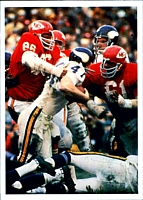
The Vikings playing against the Chiefs in Super Bowl IV.
On March 7, 1967, Fran Tarkenton was traded to the New York Giants for first- and second-round selections in the 1967 draft, a first-round selection in 1968, and a second-round selection in 1969. With these picks, Minnesota selected Clinton Jones and Bob Grim in 1967, Ron Yary in 1968, and Ed White in 1969.
During the late 1960s, the Vikings were building a powerful defense known as the Purple People Eaters, led by Alan Page, Carl Eller, Gary Larsen, and Jim Marshall. In 1968, that stingy defense earned the Vikings their first Central Division title and their first playoff berth. They lost to Baltimore 24–14 in the Western Conference championship game.
In 1969 the Vikings earned a 12–2 record, the best in the NFL. An opening-game one-point loss to the New York Giants, quarterbacked by former Viking Fran Tarkenton, was followed by 12 consecutive wins. The Vikings played their first regular-season game in Minneapolis, when the October 5 game against the Packers was moved to Memorial Stadium. That game also saw a then-record home crowd of 60,740. The Vikings defeated the Cleveland Browns 27–7 in the NFL Championship Game on January 4, 1970, at Metropolitan Stadium. Minnesota became the first modern NFL expansion team to win an NFL Championship Game, which earned the team a berth in Super Bowl IV. The heavily favored[citation needed] Vikings lost that game to the Kansas City Chiefs, 23–7, at Tulane Stadium in New Orleans.
The team continued to shine in 1970 and 1971 as their "Purple People Eater" defense led them back to the playoffs. In 1971, the defense was so impressive that Alan Page became the first-ever defensive player to win the NFL Most Valuable Player Award (MVP). The first post-merger game was a rematch with Kansas City, which the Vikings won 27–10. However, quarterback Joe Kapp had been traded away during the 1970 offseason, and his replacement, Gary Cuozzo, delivered some quite mediocre performances. Nonetheless, the defense carried the team to a 12–2 regular season record and the top of the newly created NFC Central division. They lost the divisional round of the playoffs to San Francisco, 17–14. Continued strong defense made up for Cuozzo's shortcomings as the Vikings won their division again in 1971 with an 11–3 record. The 1971 season saw the Vikings play their first regular season game on artificial turf, when they played Philadelphia at Veterans Stadium October 10. For the second year in a row, they lost the divisional round at home, this time to Dallas (the score being 20–12) in the first NFL game played on Christmas Day.
During this period, the issue of a new stadium began to surface. Metropolitan Stadium had originally been designed for baseball and was inadequate for an NFL team, seating 48,500 when the league now required a capacity of at least 50,000. Also, the stadium experienced harsh weather conditions late in the season. As the coldest venue in the NFL, it provided a considerable home field advantage to the Vikings, but was miserable for players, staff, and fans after October. However, no replacement was available for the time being.
On January 27, 1972, the Vikings decided to get Fran Tarkenton back. In exchange for him, they traded Norm Snead, Bob Grim, Vince Clements, and a first-round selection in 1972 and 1973 to the New York Giants. While the acquisitions of Tarkenton and wide receiver John Gilliam improved the passing attack, the running game was inconsistent, and the Vikings finished with a disappointing 7–7 record. The Vikings addressed the problem by drafting running back Chuck Foreman with their first pick in the 1973 draft. Co-owner Bill Boyer died on February 19, 1973 and was replaced on the team's board of directors by his son-in-law Jack Steele.
The Vikings won their first nine games of 1973 and finished the season with a 12–2 record. In the playoffs, they defeated the Washington Redskins 27–20 and the Dallas Cowboys 27–10. On January 13, 1974, the Vikings played the second Super Bowl in franchise history, Super Bowl VIII, against the Miami Dolphins at Rice Stadium in Houston, Texas. The Dolphins prevailed 24–7.
The Vikings won the Central Division again in 1974 with a 10–4 record. In the playoffs, they built on their cold weather reputation, defeating both the St. Louis Cardinals30–14 and the Los Angeles Rams14–10 in frozen Metropolitan Stadium. On January 12, 1975, The Vikings played in their second straight Super Bowl, Super Bowl IX (3rd overall), losing to the Pittsburgh Steelers, 16–6, at Tulane Stadium in New Orleans. In 1975, Mike Lynn, who had been hired the previous year as an assistant to Max Winter, was named general manager of the Vikings.
In 1975, the Vikings, led by MVP Tarkenton and Chuck Foreman, finished 12–2, losing only to Detroit and Washington while remaining undefeated until late in the season. However, the Vikings lost to the Dallas Cowboys in the playoffs, 17–14, on a controversial touchdown pass from Cowboys quarterback Roger Staubach to wide receiver Drew Pearson that became known as the Hail Mary. On the Vikings' next possession, Tarkenton was sacked just short of the end zone as he stepped back to pass, but the referees refused to penalize Dallas for pass interference. Afterwards, angry fans pelted the field with snowballs and one referee was struck in the head with a beer bottle, mimicking an incident two weeks earlier during the regular season finale in Buffalo where Foreman was hit in the eye with a snowball.
The Vikings finished 11–2–1 in 1976, winning their division once again and beating Washington at home, 35–20. They then won the NFC Championship in the last playoff game at Metropolitan Stadium over the Los Angeles Rams, 24–13, to advance to their third Super Bowl in four years. However, a championship continued to elude them when they lost to Oakland 32–14 at the Rose Bowl in Pasadena, California on January 9, 1977. Co-owner Ole Haugsrud died on March 13, 1976, and his widow, Margaret, took his place on the team's board of directors. In 1977, team attorney Sheldon Kaplan replaced Ridder on the board. Co-owner H. P. Skoglund died on November 5, 1977. In 1978, John Skoglund replaced his father on the team's board of directors, and general manager Mike Lynn replaced Margaret Haugsrud on the board.
In 1977, Minnesota again won the Central with a 9–5 record, but the team was showing signs of age. Fran Tarkenton had torn his ACL in the previous season's playoff game with the Redskins and lost the ability to perform his trademark scrambling. After years of beating the Rams in frozen Metropolitan Stadium, they finally had to go to Los Angeles for the divisional round due to receiving the #3 playoff seed and being denied home advantage. Instead of bright sunshine, there were heavy rains that turned the Los Angeles Memorial Coliseum into a mud bath, and the Vikings prevailed 14–7 on Monday December 26. On January 1, 1978, the Vikings played the Dallas Cowboys in their fourth NFC Championship Game in five years at Texas Stadium. Minnesota lost to the eventual Super Bowl champions, 23–6.
By 1978, age was taking its toll on the Vikings, but they still took advantage of a weak division to make the playoffs with an 8–7–1 record. The team had all but run out of gas as the Rams finally defeated them 34–10 in Los Angeles. Fran Tarkenton retired at the end of the season just short of his 39th birthday.
Isin:
IF0GDD6DJBVP
Out of Stock In StockBackorderedOut of Stock
IBspot Buyer Protection
Shop confidently on IBspot, receive your item as described or your money back for eligible orders. Learn Program Terms
30 days money back guarantee, no additional fee charged.
EXCELLENT SUPPORT
We provide 24/7 online customer support via email.
Fast Shipping
One week domestic shipping. Global delivery to the US in 2 weeks.
You will receive (1) one CUSTOM MADE diecut decal sheet
CREATED FOR THE OLD OPI / AA (Orange Products Inc) helmet shells with the logo
made for the:
2024 - Current (BLACK SHELL Lunar Eclipse Alt) Minnesota Vikings Fan Favorite Helmet
TAKE NOTE: See extra pictures
as reference.
The CUSTOM MADE diecut decal sheet will arrive ready for
you to peel and stick! The die cut decal sheet gives you the PERFECT EDGE on
the decals!
You can assemble your miniature football helmet, just like
the old days when we would get them in the 25 cent gumball helmet machines at
the grocery store ... or in the old JCPenney or Sears OPI Yellow Field Goal
mini miniature NFL AFL NFC AFC helmet kits and Candy Gum Toy Machines NFL
emblems from the 1970’s and 1980’s and 1990’s
Good luck! And remember, shipping is ALWAYS free for my
*DECAL SHEET ONLY* Specials! Order as many as you need! Please try
to buy more than one decal … stamps are getting expensive!
The decal sheet will come from a non-smoking home in
BEAUTIFUL Upstate NY
Bill Boyer served as the team president from 1960 to 1964. Joe Thomas was hired as head scout. Minnesota's first management team was led by general manager Bert Rose, who was appointed as GM on August 5, 1960. In an article on August 6, 1960, in the Minneapolis Tribune, it was reported that the team would use the name "Minnesota" instead of "Minneapolis–Saint Paul". The article also stated that several nicknames were suggested for the team, including "Chippewas", "Miners", "Vikings" and "Voyageurs".[1] The team was officially named the Minnesota Vikings on September 27, 1960; the name is partly meant to reflect Minnesota's place as a center of Scandinavian American culture. From the start, the Vikings embraced an energetic marketing program that produced a first-year season ticket sales of nearly 26,000 and an average home attendance of 34,586, about 85 percent of the 40,800-seat capacity of Metropolitan Stadium in Bloomington. Eventually, the stadium's capacity was increased to 47,900. On January 18, 1961, the Vikings named Norm Van Brocklin as head coach after Winnipeg Blue Bombers head coach Bud Grant turned down the job.
The Vikings' trademark horned helmet and purple-and-gold uniforms were designed by Los Angeles Examiner cartoonist Karl Hubenthal. Bert Rose and Norm Van Brocklin both knew Hubenthal from their days in Los Angeles—Rose having served as the Rams' public relations director, and Van Brocklin having played as their quarterback. Rose, an alumnus of the University of Washington, instructed Hubenthal to produce a uniform using the same colors as his alma mater. Hubenthal also composed the Vikings' original Norseman logo. The team has retained the basic elements of all those designs to the present day.[2]
The Vikings played their first game, an exhibition game, against the Dallas Cowboys on August 5, 1961. The game was played at Howard Wood Field in Sioux Falls, South Dakota. The Vikings won their first regular-season game, defeating the Chicago Bears 37–13 on the opening day of 1961. Rookie Fran Tarkenton replaced starting quarterback George Shaw to throw four touchdown passes and run for another to lead the upset. The expansion team lost its next seven games on its way to a 3–11 record.
The team's second season in 1962 was the first, and to date, only season in franchise history in which the team failed to win at least three games. It is also the worst season ever by regular season winning percentage in Vikings' history.
Rose resigned from his position as GM on June 1, 1964. Jim Finks, then-general manager of the Calgary Stampeders, was named his successor on September 11, 1964. The Vikings had their first winning season in 1964, finishing with 8 wins, 5 losses and 1 tie. The 1964 season is also remembered by fans for a road game against the San Francisco 49ers in which defensive end Jim Marshall picked up a fumble and ran it to the wrong end zone.[3] He thought he had scored a touchdown for the Vikings, but instead had scored a safety for the 49ers. The Vikings did go on to win the game, 27–22. 1964 was also the only season that the Vikings wore white jerseys at home games. This led to confusion when the Detroit Lions came to Bloomington with only their white jerseys. The game started with both teams wearing white jerseys. The Vikings retrieved their purple jerseys from Midway Stadium in Saint Paul. The Vikings changed from white jerseys to purple jerseys on the sidelines. That led to the Vikings wearing all-purple uniforms.[citation needed]
Max Winter became the team president in 1965. The Vikings played their first regular season night game and first regular season non Sunday game, when they played the New York Giants Saturday night October 9, 1965 at Met Stadium. In November of that year, the volatile Van Brocklin quit one day after the team had been eliminated from the postseason in a 41–21 defeat to the Baltimore Colts, but came back 24 hours later. Two months after that brief departure, Van Brocklin signed a new contract that would keep him with the franchise through 1970, but then quit for good, abruptly announcing his departure on February 11, 1967, saying he had lost control of the team, and the Vikings once again pursued the services of Bud Grant, who was still with Winnipeg. This time, Grant accepted the Vikings' offer and became the new Vikings head coach on March 11, 1967.
The Vikings playing against the Chiefs in Super Bowl IV.
On March 7, 1967, Fran Tarkenton was traded to the New York Giants for first- and second-round selections in the 1967 draft, a first-round selection in 1968, and a second-round selection in 1969. With these picks, Minnesota selected Clinton Jones and Bob Grim in 1967, Ron Yary in 1968, and Ed White in 1969.
During the late 1960s, the Vikings were building a powerful defense known as the Purple People Eaters, led by Alan Page, Carl Eller, Gary Larsen, and Jim Marshall. In 1968, that stingy defense earned the Vikings their first Central Division title and their first playoff berth. They lost to Baltimore 24–14 in the Western Conference championship game.
In 1969 the Vikings earned a 12–2 record, the best in the NFL. An opening-game one-point loss to the New York Giants, quarterbacked by former Viking Fran Tarkenton, was followed by 12 consecutive wins. The Vikings played their first regular-season game in Minneapolis, when the October 5 game against the Packers was moved to Memorial Stadium. That game also saw a then-record home crowd of 60,740. The Vikings defeated the Cleveland Browns 27–7 in the NFL Championship Game on January 4, 1970, at Metropolitan Stadium. Minnesota became the first modern NFL expansion team to win an NFL Championship Game, which earned the team a berth in Super Bowl IV. The heavily favored[citation needed] Vikings lost that game to the Kansas City Chiefs, 23–7, at Tulane Stadium in New Orleans.
The team continued to shine in 1970 and 1971 as their "Purple People Eater" defense led them back to the playoffs. In 1971, the defense was so impressive that Alan Page became the first-ever defensive player to win the NFL Most Valuable Player Award (MVP). The first post-merger game was a rematch with Kansas City, which the Vikings won 27–10. However, quarterback Joe Kapp had been traded away during the 1970 offseason, and his replacement, Gary Cuozzo, delivered some quite mediocre performances. Nonetheless, the defense carried the team to a 12–2 regular season record and the top of the newly created NFC Central division. They lost the divisional round of the playoffs to San Francisco, 17–14. Continued strong defense made up for Cuozzo's shortcomings as the Vikings won their division again in 1971 with an 11–3 record. The 1971 season saw the Vikings play their first regular season game on artificial turf, when they played Philadelphia at Veterans Stadium October 10. For the second year in a row, they lost the divisional round at home, this time to Dallas (the score being 20–12) in the first NFL game played on Christmas Day.
During this period, the issue of a new stadium began to surface. Metropolitan Stadium had originally been designed for baseball and was inadequate for an NFL team, seating 48,500 when the league now required a capacity of at least 50,000. Also, the stadium experienced harsh weather conditions late in the season. As the coldest venue in the NFL, it provided a considerable home field advantage to the Vikings, but was miserable for players, staff, and fans after October. However, no replacement was available for the time being.
On January 27, 1972, the Vikings decided to get Fran Tarkenton back. In exchange for him, they traded Norm Snead, Bob Grim, Vince Clements, and a first-round selection in 1972 and 1973 to the New York Giants. While the acquisitions of Tarkenton and wide receiver John Gilliam improved the passing attack, the running game was inconsistent, and the Vikings finished with a disappointing 7–7 record. The Vikings addressed the problem by drafting running back Chuck Foreman with their first pick in the 1973 draft. Co-owner Bill Boyer died on February 19, 1973 and was replaced on the team's board of directors by his son-in-law Jack Steele.
The Vikings won their first nine games of 1973 and finished the season with a 12–2 record. In the playoffs, they defeated the Washington Redskins 27–20 and the Dallas Cowboys 27–10. On January 13, 1974, the Vikings played the second Super Bowl in franchise history, Super Bowl VIII, against the Miami Dolphins at Rice Stadium in Houston, Texas. The Dolphins prevailed 24–7.
The Vikings won the Central Division again in 1974 with a 10–4 record. In the playoffs, they built on their cold weather reputation, defeating both the St. Louis Cardinals30–14 and the Los Angeles Rams14–10 in frozen Metropolitan Stadium. On January 12, 1975, The Vikings played in their second straight Super Bowl, Super Bowl IX (3rd overall), losing to the Pittsburgh Steelers, 16–6, at Tulane Stadium in New Orleans. In 1975, Mike Lynn, who had been hired the previous year as an assistant to Max Winter, was named general manager of the Vikings.
In 1975, the Vikings, led by MVP Tarkenton and Chuck Foreman, finished 12–2, losing only to Detroit and Washington while remaining undefeated until late in the season. However, the Vikings lost to the Dallas Cowboys in the playoffs, 17–14, on a controversial touchdown pass from Cowboys quarterback Roger Staubach to wide receiver Drew Pearson that became known as the Hail Mary. On the Vikings' next possession, Tarkenton was sacked just short of the end zone as he stepped back to pass, but the referees refused to penalize Dallas for pass interference. Afterwards, angry fans pelted the field with snowballs and one referee was struck in the head with a beer bottle, mimicking an incident two weeks earlier during the regular season finale in Buffalo where Foreman was hit in the eye with a snowball.
The Vikings finished 11–2–1 in 1976, winning their division once again and beating Washington at home, 35–20. They then won the NFC Championship in the last playoff game at Metropolitan Stadium over the Los Angeles Rams, 24–13, to advance to their third Super Bowl in four years. However, a championship continued to elude them when they lost to Oakland 32–14 at the Rose Bowl in Pasadena, California on January 9, 1977. Co-owner Ole Haugsrud died on March 13, 1976, and his widow, Margaret, took his place on the team's board of directors. In 1977, team attorney Sheldon Kaplan replaced Ridder on the board. Co-owner H. P. Skoglund died on November 5, 1977. In 1978, John Skoglund replaced his father on the team's board of directors, and general manager Mike Lynn replaced Margaret Haugsrud on the board.
In 1977, Minnesota again won the Central with a 9–5 record, but the team was showing signs of age. Fran Tarkenton had torn his ACL in the previous season's playoff game with the Redskins and lost the ability to perform his trademark scrambling. After years of beating the Rams in frozen Metropolitan Stadium, they finally had to go to Los Angeles for the divisional round due to receiving the #3 playoff seed and being denied home advantage. Instead of bright sunshine, there were heavy rains that turned the Los Angeles Memorial Coliseum into a mud bath, and the Vikings prevailed 14–7 on Monday December 26. On January 1, 1978, the Vikings played the Dallas Cowboys in their fourth NFC Championship Game in five years at Texas Stadium. Minnesota lost to the eventual Super Bowl champions, 23–6.
By 1978, age was taking its toll on the Vikings, but they still took advantage of a weak division to make the playoffs with an 8–7–1 record. The team had all but run out of gas as the Rams finally defeated them 34–10 in Los Angeles. Fran Tarkenton retired at the end of the season just short of his 39th birthday.
Sport: Football
Size: Miniature
Color: Black
Product: Helmet
Team: Minnesota Vikings
Processing Time
We process and ship orders Monday through Friday, excluding holidays.
Most orders are processed within 1–3 business days, depending on product availability.
Processing time does not include delivery time, which varies based on your location and the product’s shipping origin.
Shipping Coverage
We currently ship to addresses within the United States only.
Products may ship from:
Our U.S. warehouses, or
Our international fulfillment centers (including Korea, Japan, China, Australia, Mexico, Canada, the United Kingdom, and the EU).
Each product page clearly displays the “Ships From” location before checkout.
Shipping Methods & Estimated Delivery
Shipping Method
Estimated Delivery
Cost
Free Shipping (US)
5–10 business days
Free, available on eligible items
Standard Shipping (US to US by Item)
5–10 business days
$6.50 for the first item, $2.00 each additional
Standard Shipping (From US Warehouse by Weight)
3–7 business days
Starts at $6.50, increasing by $2 for every additional 4 oz (0.25 lb) up to 1 lb, then by $4 for each additional pound beyond 1 lb.
Extended Delivery (Ships from Overseas Warehouse)
10–20 business days
$14.50 for the first item, $2.00 each additional
Shipping costs vary by product weight, quantity and origin. Exact rates and delivery estimates are displayed on each product page and confirmed during checkout.
Free Shipping
We offer free standard shipping on select products or during promotional periods. Availability of free shipping will be displayed on the product page and at checkout.
Carriers
We primarily use USPS and UPS for U.S. deliveries. Items shipped from international warehouses may be handled by partner carriers depending on the country of origin.
Import Duties & Taxes
All import duties and taxes for goods imported into the United States are included in the product price. There are no hidden fees or additional charges at checkout.
Tracking & Notifications
Every order is fully trackable. You will receive a tracking number via email once your order ships. If your order ships in multiple packages, each package will have its own tracking number. If you don’t receive a shipping confirmation immediately, your order is still being processed and will arrive within the estimated timeframe shown at checkout.
You can track your shipment anytime using the Track Your Order page on our website.
Order Changes & Cancellations
If you need to modify or cancel an order, please contact our customer support team as soon as possible. Orders can only be canceled before they ship. Once shipped, cancellations are not possible, but you may request a return after the item is delivered.
If your tracking number shows “Delivered” but you haven’t received your package:
Check with your local USPS or UPS office.
Confirm that the shipping address provided was correct.
If the issue remains unresolved, contact support@ibspot.com for assistance.
Damaged or Lost Parcels
If your package arrives damaged or fails to arrive, please contact us immediately. For deliveries to P.O. boxes, ibspot is not responsible for damage caused by weather, temperature, or theft.
Customer Support
For any questions about shipping, tracking, or delivery, our customer support team is here to help.
Please read our policy carefully before making a purchase.
We aim to ensure every customer has a smooth and transparent experience with ibspot.com.
Order Cancellation Policy
Customers may request to cancel an order before it has been shipped.
Once the package has been shipped, cancellations are no longer possible; however, you may still request a return after receiving your order.
Contact Form: Submit a request through our Contact Us page
Please submit your cancellation request as soon as possible after placing the order to allow us to process it before shipment.
Return Policy
We accept returns for most items within 30 days of delivery for a full refund.
To be eligible for a return:
The item must be unused, in the same condition as received, and in its original packaging.
A tracking number must be provided to confirm the return shipment.
Non-Returnable Items
Certain products cannot be returned, including:
Perishable goods (for example, food, flowers, newspapers, magazines)
Intimate or sanitary goods
Hazardous materials or flammable liquids/gases
Gift cards
Downloadable software
Some health and personal care items
Partial Refunds (If Applicable)
Partial refunds may be granted in specific situations, such as:
Books with obvious signs of use
Opened CDs, DVDs, software, or vinyl records
Items not in their original condition, damaged, or missing parts not due to our error
Items returned more than 30 days after delivery
How to Return an Item
To initiate a return, please contact us at support@ibspot.com with your order number and details about the product you wish to return.
Our team will provide you with return instructions and a prepaid return label.
Shipping Cost for Returns
Please contact us before returning any item.
We will provide a free return shipping label.
If a return is sent back without prior contact or without our provided label, we cannot be held responsible for return shipping costs.
For items valued over $75, we recommend using a trackable shipping service or purchasing shipping insurance.
We cannot guarantee that we will receive your returned item if shipped independently.
Refund Processing
Once your return is received and inspected:
In-store returns are refunded to the original form of payment or issued as a gift card.
Mail-in returns using our prepaid label are refunded to the original payment method within 3–5 business days after we receive your return.
Please allow:
5–7 business days for the return to reach our Returns Center.
An additional 3–10 business days for your bank to post the refund to your account.
Damages, Issues & Claims
Please inspect your order immediately upon receipt.
If you receive a defective, damaged, or incorrect item, contact us right away at support@ibspot.com.
We’ll evaluate the issue promptly and make it right.
Product Claims
Before purchasing, please review product details carefully.
If there is a problem with your order upon arrival, visit our Support Center or contact us directly to arrange return shipping or replacement.
Exchanges
We do not process direct exchanges.
The fastest way to get what you need is to return the original item and place a new order once your return is accepted.
Return Address
IBSPOT Return Center
15 Sawmill Ln
Dover Plains, NY 12522
United States
Customer Support
Our support team is available 24/7 to assist with cancellations, returns, or general inquiries.
Sorry, it looks like some products are not available in selected quantity.
OK
Subscribe To Our Newsletter
Disclaimer: Statements made, or products sold through this website, have not been evaluated by the United States Food and Drug Administration. Products are not intended to diagnose, treat, cure or prevent any disease.
Update your settings
Set where you live, what language you speak, and the currency you use.